How to Increase Sales Using SEO + AEO + GEO | A2Z DigiRanx
By A2Z DigiRanx Team | Digital Marketing | 12 min read
Ranking on Google is no longer enough.
In 2026, businesses that want to increase sales need to master three interconnected disciplines — Search Engine Optimisation (SEO), Answer Engine Optimisation (AEO), and Generative Engine Optimisation (GEO).
This guide breaks down exactly how each works, how they connect, and how combining all three creates a compounding sales engine for your business.
Table of Contents
What Has Changed in Search — And Why It Affects Your Sales
A decade ago, a business that ranked in the top three positions on Google could reliably count on traffic, leads, and sales. The search experience was simple: a user typed a query, Google showed ten blue links, and users clicked. That world has changed fundamentally.
Google’s Search Generative Experience (SGE), AI Overviews, and tools like ChatGPT, Perplexity, and Google Gemini have restructured how people find information and make purchasing decisions. Studies estimate that AI-generated answers now appear at the top of a significant portion of search results, meaning many users get their answer without ever clicking a single link. Meanwhile, voice search through Alexa, Siri, and Google Assistant has made question-based queries the fastest-growing segment of search behaviour.
For businesses, this means the old playbook of “rank and collect traffic” needs a serious upgrade. Three disciplines now govern whether a brand gets discovered, trusted, and ultimately chosen by a buying customer: SEO, AEO, and GEO. Understanding each one — and more importantly, understanding how they reinforce each other — is what separates businesses that grow their sales online in 2026 from those that are slowly becoming invisible.
If your business is still relying on outdated tactics, it may be time to work with a professional digital marketing agency that understands the evolving landscape. You can also explore the full range of growth services available on the A2Z DigiRanx homepage to understand where your business stands today.
SEO in 2026: The Foundation That Never Goes Away
Search Engine Optimisation is the practice of making your website and content more visible in organic (non-paid) search results. Despite repeated proclamations of its death, SEO remains the single highest-return long-term digital marketing investment a business can make. The rules, however, have evolved significantly.
What Modern SEO Actually Means for Sales
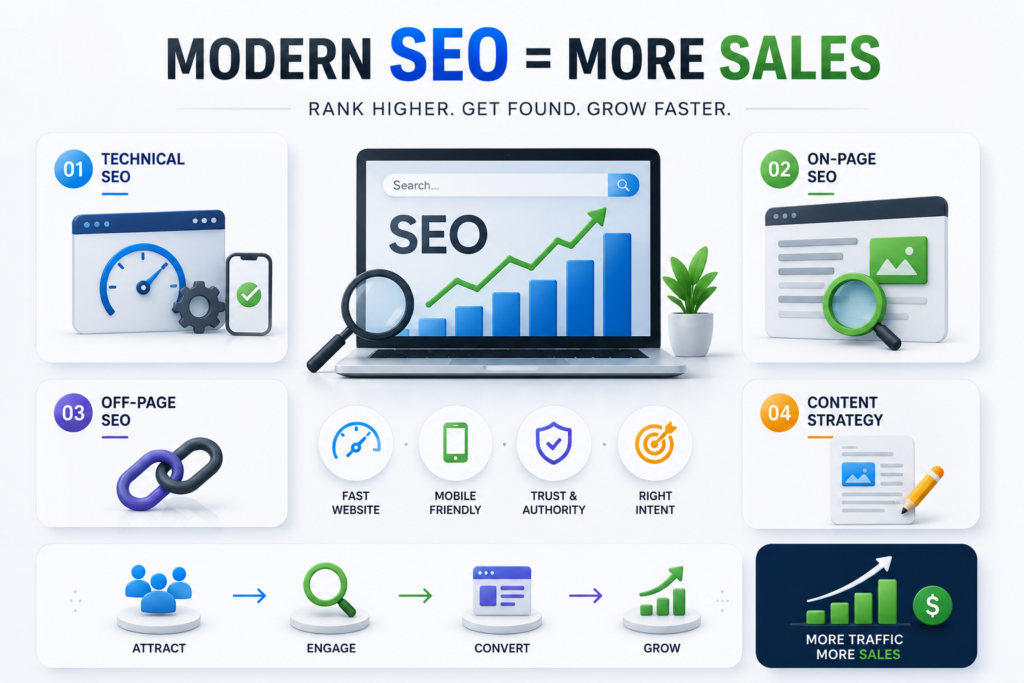
Modern SEO is not about stuffing keywords onto a page. It is about demonstrating to search engines — and to users — that your content, your website, and your brand are the most trustworthy, relevant, and useful source for a given topic. Google evaluates this through a combination of technical signals (site speed, crawlability, mobile-friendliness), on-page signals (content quality, keyword relevance, heading structure), and off-page signals (backlinks, brand mentions, domain authority).
From a sales perspective, the most important SEO shift in recent years is the emphasis on search intent. Google has become extremely good at understanding what a user actually wants when they type a query, not just the literal words they used. A user searching “best CRM for small business” wants a comparison, not a product page. A user searching “buy CRM software” is ready to purchase. Optimising for the right intent at the right stage of the buying journey is what turns SEO traffic into actual sales.
Technical SEO Elements That Drive Revenue
Core Web Vitals — Google’s metrics for page loading speed, visual stability, and interactivity — directly affect both rankings and conversion rates. A page that loads slowly loses both its ranking position and the patience of potential customers. Structured data markup (Schema.org) helps search engines understand the precise meaning of your content, enabling rich results like star ratings, price displays, and FAQ snippets that significantly improve click-through rates from search results pages.
Internal linking is another underutilised SEO lever with a direct sales impact. When your blog content links intelligently to your product or service pages, it passes authority to those pages while guiding potential customers deeper into your funnel. To see how a fully optimised digital presence looks in practice, visit our digital marketing services page and explore how each channel connects to revenue.
AEO: Getting Found When People Ask Questions
Answer Engine Optimisation is the practice of structuring your content so that it is selected as the direct answer when someone asks a question — whether through a Google search, a voice assistant, or an AI chatbot. The term “answer engine” reflects the reality that search tools are increasingly behaving less like directories and more like knowledgeable assistants that give you one authoritative answer rather than ten links to explore.
Why AEO Directly Increases Sales
When your content becomes the featured snippet for a high-intent query — “What is the best digital marketing strategy for small businesses?” or “How long does SEO take to show results?” — you capture visibility that no paid ad can easily displace. More importantly, appearing as the authoritative answer to questions your potential customers are asking creates a trust signal that influences purchase decisions before the user has even visited your website.
Voice search amplifies this effect dramatically. When a user asks Alexa or Siri a question, the device reads out a single answer. If your content is that answer, you have just reached a potential customer with zero competition and zero cost per click. As smart speakers and voice-enabled devices continue to grow in Indian households and offices, AEO is becoming increasingly important for local and national businesses alike.
How to Optimise for Answer Engines
The mechanics of AEO centre on three practices. First, identify the specific questions your target customers ask at each stage of their buying journey — from awareness questions (“What is generative AI?”) to decision questions (“Which digital marketing agency should I hire?”). Tools like Google’s “People Also Ask” section, AnswerThePublic, and your own sales team’s FAQ list are excellent sources.
Second, structure your content to answer those questions directly and concisely. The ideal featured snippet answer is 40 to 60 words for a paragraph snippet, or a clean numbered or bulleted list for process-oriented questions. Begin the paragraph with a direct answer to the question, then provide supporting context. Do not bury the answer in preamble.
Third, implement FAQ Schema markup on your pages. This structured data signals to Google and other answer engines that your content is formatted as a question-and-answer resource, making it significantly more likely to be selected for voice search responses and featured snippets.
Quick AEO Checklist: Use question-based H2/H3 headings. Answer the question in the first 1–2 sentences under each heading. Keep answers between 40–60 words for paragraph snippets. Implement FAQ Schema on key pages. Target “People Also Ask” queries in your niche. Not sure where to start? Our team at A2Z DigiRanx Meerut can audit your existing content for AEO gaps.
GEO: Appearing Inside AI-Generated Answers
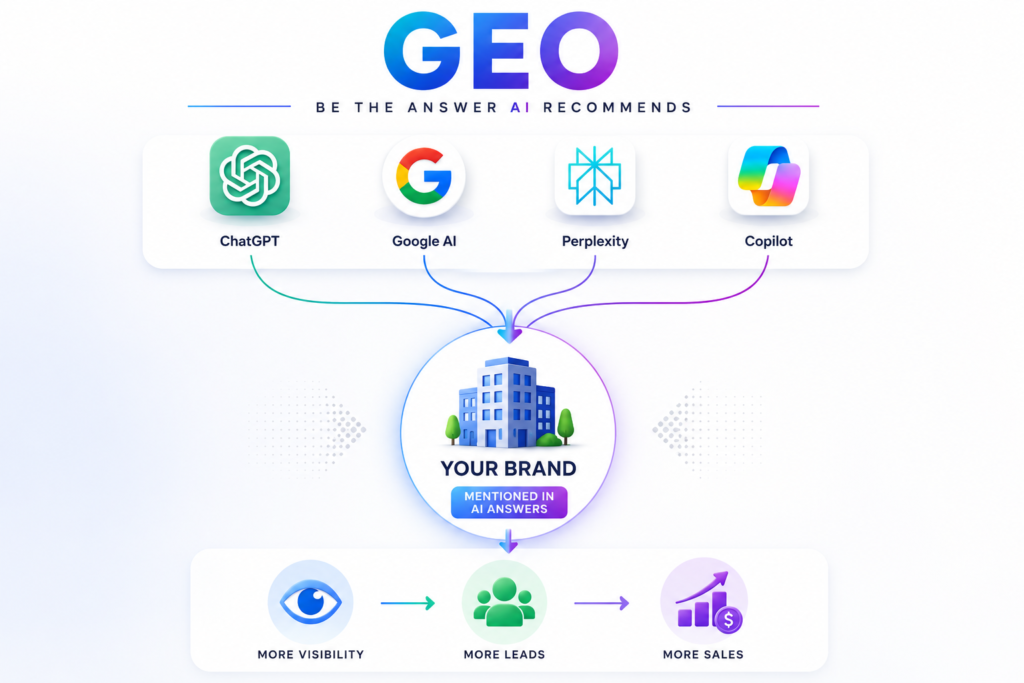
Generative Engine Optimisation is the newest of the three disciplines and the one most businesses are not yet thinking about. GEO refers to optimising your content and brand presence so that when AI tools like ChatGPT, Google’s AI Overview, Perplexity AI, or Microsoft Copilot generate an answer on a topic relevant to your business, your brand, your content, or your products are referenced or cited within that answer.
How AI Tools Decide What to Cite
Generative AI tools do not simply pull from the top Google results. They synthesise information from a wide range of sources and prioritise content that is authoritative, well-structured, detailed, and clearly attributed to a credible source. Several factors influence whether your content gets cited in an AI-generated answer: domain authority, the presence of specific factual data and statistics, clarity of writing, use of structured formatting (headings, lists, tables), and whether your brand is mentioned across multiple credible online sources.
This is why GEO is sometimes described as “digital PR meets content strategy.” Building genuine backlinks from reputable publications, getting mentioned in industry roundups, having your team members quoted as experts, and consistently publishing in-depth original research all contribute to the brand authority signals that AI tools use when deciding whose content to reference.
GEO Tactics That Drive Sales
The most effective GEO tactics for businesses focused on sales are as follows. Publish long-form, expert-level content on topics central to your industry. AI tools are trained to favour content that goes deeper than surface-level summaries. Include original data, case studies, and specific statistics — AI systems are more likely to cite content that contains verifiable, unique information rather than generic advice.
Build your brand’s presence on platforms that AI models frequently draw from: Wikipedia (for established brands), LinkedIn (for professional expertise), industry publications, and authoritative news outlets. When an AI tool encounters your brand name cited consistently across trusted sources, it treats your content as higher authority.
Ensure your content is structured for machine readability. Use clear headings, concise definitions, tables that compare options, and numbered processes. AI models parse structured content more reliably than dense, unformatted prose. Optimising for GEO, AEO, and SEO simultaneously is one of the core services offered through A2Z DigiRanx’s digital growth programmes. If you are based in Meerut or nearby regions, our local digital marketing specialists can help you build the authority signals that AI tools prioritise.
Discipline
Primary Goal
Where You Appear
Key Tactic
SEO
Organic rankings
Google / Bing search results
Technical optimisation + backlinks
AEO
Featured snippets & voice
Answer boxes, voice assistants
Question-based content + FAQ Schema
GEO
AI-generated citations
ChatGPT, AI Overviews, Perplexity
Expert content + digital authority
How SEO + AEO + GEO Work Together to Drive Sales
The real power of this framework is not in any single discipline but in the compounding effect when all three are implemented together. Here is how a single piece of well-optimised content can work across all three channels simultaneously to drive sales.
Imagine your business publishes a detailed guide titled “How to Choose a Digital Marketing Agency in Meerut.” Properly optimised for SEO, this page ranks in the top three results for that query, driving consistent organic traffic from potential clients actively researching agencies. Structured with AEO principles — a direct answer in the opening, question-based headings, FAQ Schema — it is also selected as the featured snippet for voice queries like “which digital marketing agency should I hire in Meerut.” And because it contains original insights, specific data, and demonstrates genuine expertise, it gets cited in AI-generated answers when ChatGPT or Perplexity users ask about digital marketing services in the region.
That single piece of content is now generating three distinct streams of awareness, trust, and traffic — all pointing toward the same sales conversion. This is the compounding effect of integrated SEO + AEO + GEO strategy, and it is what separates businesses that grow predictably online from those chasing vanishing returns from single-channel approaches.
The businesses best positioned to capitalise on this are those working with agencies that understand all three disciplines, not just traditional search rankings. You can learn more about what a results-driven digital marketing agency in Meerut can do for your sales growth. For a broader look at the services and industries we work with, the A2Z DigiRanx website is a good starting point.
A Practical Step-by-Step Strategy to Implement All Three
Step 1: Audit Your Current Search Presence
Before building forward, understand where you currently stand. Use Google Search Console to identify which queries already bring you traffic. Use a tool like Ahrefs, SEMrush, or Ubersuggest to assess your domain authority and keyword rankings. Check whether your brand is mentioned in any AI-generated answers by testing relevant queries in ChatGPT and Perplexity. This baseline tells you exactly where the gaps are across SEO, AEO, and GEO.
Step 2: Build a Unified Content Pillar Strategy
Map out three to five core topic areas that directly relate to what your customers need before they buy from you. For each topic, create a comprehensive pillar page (2,000+ words covering the topic in full depth) supported by several shorter cluster articles targeting specific sub-questions. This architecture signals topic authority to Google (SEO), provides the detailed question-and-answer structure that answer engines select (AEO), and creates the kind of expert resource that AI tools cite (GEO).
Step 3: Optimise Every Page for All Three Disciplines Simultaneously
Each page you publish should have its primary target keyword appearing naturally at the target density — approximately 0.6 percent of total word count — in the title, the opening paragraph, one or two subheadings, and distributed naturally throughout the text. Structure the content with question-based H2 and H3 headings. Include a FAQ section at the bottom with Schema markup. Ensure the page loads in under two seconds and is fully mobile-responsive. Link internally to relevant service pages or related articles from every post.
Step 4: Build Authority Through Digital PR
For GEO specifically, content alone is not sufficient. You need your brand to be cited by other reputable sources. Reach out to industry publications for guest posting opportunities. Issue press releases about genuine business milestones. Participate in industry roundups and expert commentary requests. Ensure your Google Business Profile is fully optimised with accurate information, regular posts, and customer reviews. Each external citation of your brand adds to the authority signals that make AI tools more likely to reference your content.
Step 5: Implement Technical Foundations
Ensure your website has proper Schema markup for your business type — Organisation Schema, FAQPage Schema, and Article Schema at a minimum. Submit an XML sitemap to Google Search Console. Ensure all important pages are crawlable and not blocked by robots.txt. Fix any broken links, redirect chains, or duplicate content issues. Technical SEO is the infrastructure that everything else depends on, and without it, even the best content underperforms.
Measuring the Sales Impact
The only measure that ultimately matters is sales — and all three disciplines need to be tracked back to revenue impact. The most effective way to do this is through a unified measurement framework that connects search visibility to sales conversion.
Track organic traffic by channel (Google Search, direct, referral) in Google Analytics 4. Monitor keyword rankings and featured snippet appearances weekly using a rank tracking tool. Set up goal tracking in GA4 for all conversion events — form submissions, phone calls, e-commerce purchases — so you can attribute sales to specific landing pages and the traffic sources driving them.
For AEO, monitor your featured snippet wins by regularly testing your target question queries in Google incognito mode and noting which position your content holds. For GEO, test your brand and key topics monthly in ChatGPT, Perplexity, and Google’s AI Overview to see whether your content is being cited or referenced. As these mentions increase, you will typically see a corresponding lift in direct and branded search traffic — the clearest leading indicator that GEO is working.
Ready to Grow Your Sales With SEO, AEO, and GEO?
A2Z DigiRanx helps businesses build integrated search strategies that drive real revenue — not just rankings. Talk to our team today.Get a Free Strategy Call
Frequently Asked Questions
1. What is the difference between SEO, AEO, and GEO?
SEO (Search Engine Optimisation) focuses on ranking your website pages in traditional search results on Google and Bing. AEO (Answer Engine Optimisation) focuses on getting your content selected as the direct answer in featured snippets, voice search responses, and question-based results. GEO (Generative Engine Optimisation) focuses on having your brand and content cited within AI-generated answers from tools like ChatGPT, Perplexity, and Google’s AI Overview. All three are distinct but reinforce each other when implemented together.
2. Can small businesses benefit from SEO + AEO + GEO, or is this only for large companies?
Small and medium businesses often benefit more from this integrated approach than large corporations, because the playing field in AI-driven search is relatively new and less dominated by established brands. A small business that publishes expert-level content structured for all three disciplines can achieve visibility in AI-generated answers that would take years and enormous budgets to achieve in paid advertising.
3. How long does it take to see sales results from this strategy?
SEO results typically begin appearing within three to six months for new content and faster for existing sites with some authority. AEO results — featured snippet positions — can appear within weeks if your content directly and concisely answers high-volume questions. GEO results take longer, typically three to nine months, as they depend on building external citations and brand authority across multiple sources. The compound effect on sales becomes most pronounced at the six to twelve month mark when all three channels are generating traffic simultaneously.
4. What is the ideal keyword density for SEO content in 2026?
A keyword density of approximately 0.5 to 0.8 percent is considered optimal for most pages in 2026. This means a 2,000-word article should contain its primary keyword approximately 10 to 16 times, appearing naturally in the title, introduction, subheadings, and body text. Exceeding this range risks keyword stuffing penalties. More important than density is semantic relevance — using related terms and phrases that Google associates with your primary topic.
5. How do I know if my content is being cited by AI tools like ChatGPT?
The most direct method is to regularly test relevant questions in ChatGPT, Perplexity, and Google’s AI Overview and check whether your website, brand name, or specific data points are mentioned in the responses. You can also monitor for increases in branded search volume (searches specifically for your business name) and direct traffic, which often rise when AI tools are regularly referencing your brand. Some third-party tools are beginning to offer AI citation tracking as a specific metric.
6. Is voice search still relevant for business in India?
Voice search is growing rapidly in India, driven by smartphone penetration, regional language voice queries, and the increasing comfort of younger users with speaking to devices rather than typing. Google reports that a significant portion of Indian search queries are conducted by voice, and this proportion is higher in tier-2 and tier-3 cities where voice input is often more convenient than typing in a second language. Businesses targeting Indian consumers across any geography should be optimising for voice-friendly, conversational question-and-answer content.
7. Do I need separate content for SEO, AEO, and GEO?
No — this is one of the most practical advantages of the integrated approach. A single, well-structured piece of content can simultaneously serve all three purposes. A long-form article with proper keyword optimisation (SEO), question-based headings and a FAQ section with Schema markup (AEO), and original data or expert insights that build authority (GEO) will naturally perform across all three channels. The key is to build this structure intentionally rather than retrofitting it after the fact.
8. What role does internal linking play in increasing sales through SEO?
Internal linking serves two critical functions for sales. First, it passes domain authority from high-traffic content pages to your service or product pages, improving those pages’ rankings for commercial keywords. Second, it guides users who arrive on informational content (a blog post) toward the next logical step in their buying journey (a service page, a contact form, or a pricing page). A well-designed internal linking structure is one of the most underutilised conversion optimisation tools available to businesses, and it requires no additional budget beyond thoughtful content planning.
9. How important is structured data (Schema markup) for AEO and GEO?
Structured data is extremely important for AEO and increasingly relevant for GEO. For AEO, FAQPage Schema and HowTo Schema directly signal to Google that your content is formatted as a direct answer resource, increasing the probability of featured snippet and voice search selection. For GEO, structured data helps AI crawlers parse your content’s meaning more accurately, making it more likely to be accurately cited in generated responses. Implementing Organisation, Article, FAQPage, and LocalBusiness Schema on relevant pages is one of the highest-return technical investments you can make.
10. Should I hire a digital marketing agency to implement SEO + AEO + GEO, or can I do it myself?
Businesses with dedicated in-house marketing teams and technical resources can implement this strategy internally, but the learning curve is significant — particularly for technical SEO and GEO, which require expertise in structured data, content architecture, and digital PR. For most growing businesses, partnering with a specialist digital marketing agency provides faster results and more efficient use of budget, since the agency brings existing tools, relationships, and established processes. The key is choosing an agency that explicitly understands and works across all three disciplines, not one still focused exclusively on traditional keyword rankings.