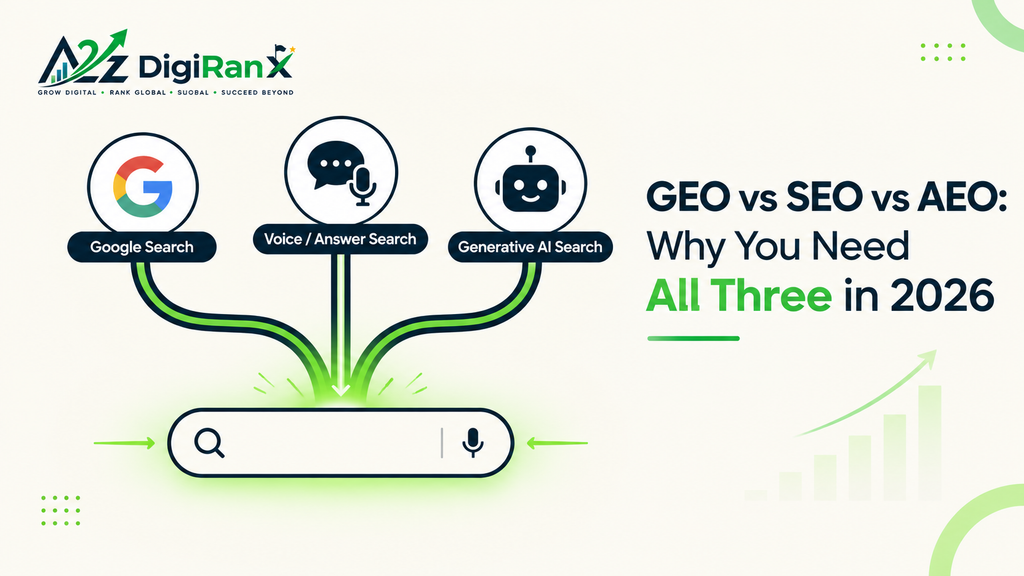
If you have spent any time researching digital marketing this year, you have probably run into three acronyms that sound similar but mean very different things: SEO, AEO, and GEO. Business owners often assume these are just marketing buzzwords or three names for the same service. They are not. Each one targets a different way people now search for information, and in 2026, ignoring any one of them means leaving visibility, and revenue, on the table.
At A2Z DigiRanX, we work with brands across Canada, the US, the UK, the Netherlands, Portugal, and India, and the single biggest shift we have seen in the last two years is this: people are no longer searching only on Google. They are asking ChatGPT, Gemini, and Perplexity for recommendations, and those tools are quietly becoming a new front door to your business. If your brand is not built for that front door, you are invisible to a growing share of your future customers.
Let us break down what SEO, AEO, and GEO actually mean, how they differ, and why a serious digital growth strategy in 2026 needs all three working together.
What is SEO (Search Engine Optimization)?
SEO is the practice you already know. It is the process of optimizing your website so it ranks higher on traditional search engines like Google and Bing. This includes technical work like site speed and mobile usability, on-page work like keyword targeting and metadata, and off-page work like backlinks and domain authority.
SEO answers one core question: when someone types a query into Google, does your website show up on page one?
Good SEO still matters enormously. Most purchase journeys still start with a Google search, and ranking on page one remains one of the highest-ROI channels in digital marketing. Our SEO, AEO & GEO services are built around this foundation, because none of the newer strategies work without it.
What is AEO (Answer Engine Optimization)?
AEO is where things start to change. Answer Engine Optimization is the practice of structuring your content so it gets picked up as a direct answer, not just a ranked link. Think about Google’s featured snippets, the “People Also Ask” boxes, voice assistant responses from Alexa or Siri, and the short, direct answers Google now shows at the top of a search page before any blue links even appear.
AEO answers a different question: when someone asks a specific question, does your content get quoted as the answer, even if the user never clicks through to your website?
This matters because a huge and growing percentage of searches now end without a single click. The user gets their answer directly on the results page. If your content is not structured for that moment, you lose the opportunity entirely, even if you technically “rank.”
To win at AEO, content needs to be written in clear, direct, question-and-answer formats, use structured data markup, and get straight to the point instead of burying the answer under three paragraphs of introduction.
What is GEO (Generative Engine Optimization)?
GEO is the newest and, in our view, the most important shift for the next five years. Generative Engine Optimization is the practice of getting your brand cited, recommended, or referenced by AI tools like ChatGPT, Gemini, Perplexity, and Claude when users ask them questions.
Here is the difference that matters: when someone asks ChatGPT “what is the best digital marketing agency for a small e-commerce brand,” the AI is not showing a list of ten blue links. It is generating one confident, conversational answer, and it is pulling that answer from sources it trusts and understands. If your brand is not part of the data these models draw from, you simply do not exist in that conversation, no matter how good your Google ranking is.
GEO involves building topical authority across the web, earning mentions on credible third-party sites, structuring your own content so AI models can parse and trust it, and consistently publishing content that answers real questions in depth rather than thin, keyword-stuffed pages. This is the exact work we do for brands through our SEO, AEO & GEO services, and it is becoming one of the most requested services from our international clients.
SEO vs AEO vs GEO: A Side-by-Side Comparison
| SEO | AEO | GEO | |
|---|---|---|---|
| Platform | Google, Bing | Featured snippets, voice search | ChatGPT, Gemini, Perplexity |
| Goal | Rank on page one | Become the direct answer | Get cited as a trusted source |
| Content style | Keyword-optimized pages | Clear Q&A format | In-depth, authoritative, well-structured |
| User outcome | Clicks to your site | Instant answer, sometimes no click | AI-generated recommendation |
| Time to results | Weeks to months | Weeks | Months, but compounding |
None of these replace the others. They stack on top of each other. A strong SEO foundation makes your site crawlable and trustworthy. Strong AEO content makes you the answer, not just a result. Strong GEO work makes you the brand that AI models recommend by name.
Why Your Business Needs All Three in 2026
Think about how your own customers behave today. A business owner in the Netherlands or a startup founder in Toronto might start their research by asking ChatGPT a broad question, get a shortlist of options, then Google one or two of those names to verify credibility, then land on a specific service page and ask a very direct question like “how much does GEO cost.” That single journey touches all three channels: GEO for discovery, SEO for verification, and AEO for the specific quick answer along the way.
Paid ads still play a role alongside organic visibility see how to choose between Google Ads and Meta Ads for your business in 2026.
If your strategy only covers traditional SEO, you are optimizing for a search behavior that is already shrinking. If you chase only the AI trend and ignore SEO fundamentals, you have no foundation for the AI models to actually trust and cite. The businesses that win in 2026 are the ones treating this as one connected visibility strategy, not three separate projects.
This is exactly why we built our agency around all three from day one. Whether it is a healthcare clinic in Dubai, a CV writing service in the UK, or an online gaming brand, the brands we work with need to show up everywhere their customers are actually looking, not just on one search engine.
How to Start Building Your GEO, AEO, and SEO Strategy
If you are not sure where your brand currently stands, here is a simple way to think about it:
- Search your own business name and top services on Google. Are you ranking, and are your meta descriptions and titles compelling enough to earn the click?
- Ask ChatGPT or Perplexity a question a potential customer might ask about your industry. Does your brand come up at all?
- Check whether your existing blog content answers real questions directly, or whether it is written mainly to stuff in keywords.
If the answer to any of these makes you uncomfortable, that is a sign it is time to build a proper strategy rather than patch things piecemeal.
Final Thoughts
SEO, AEO, and GEO are not competing strategies. They are three layers of the same goal: making sure your brand is visible, credible, and recommended everywhere your customers are searching, whether that is a Google search bar or a conversation with an AI assistant. Businesses that treat these as separate, optional add-ons will fall behind brands that build one integrated visibility strategy across all three.
If you want to see exactly where your brand stands across Google, ChatGPT, and other AI search tools, our team can run a full audit and show you precisely what is working, what is missing, and what to fix first. Book a strategy call with A2Z DigiRanX and let us help you build a brand that ranks and gets recommended everywhere it matters. You can also explore our full range of digital marketing services, or if you want to learn these skills yourself.
Pingback: Google Ads vs Meta Ads: Which One Should Your Business Choose in 2026? - A2Z DigiRanX