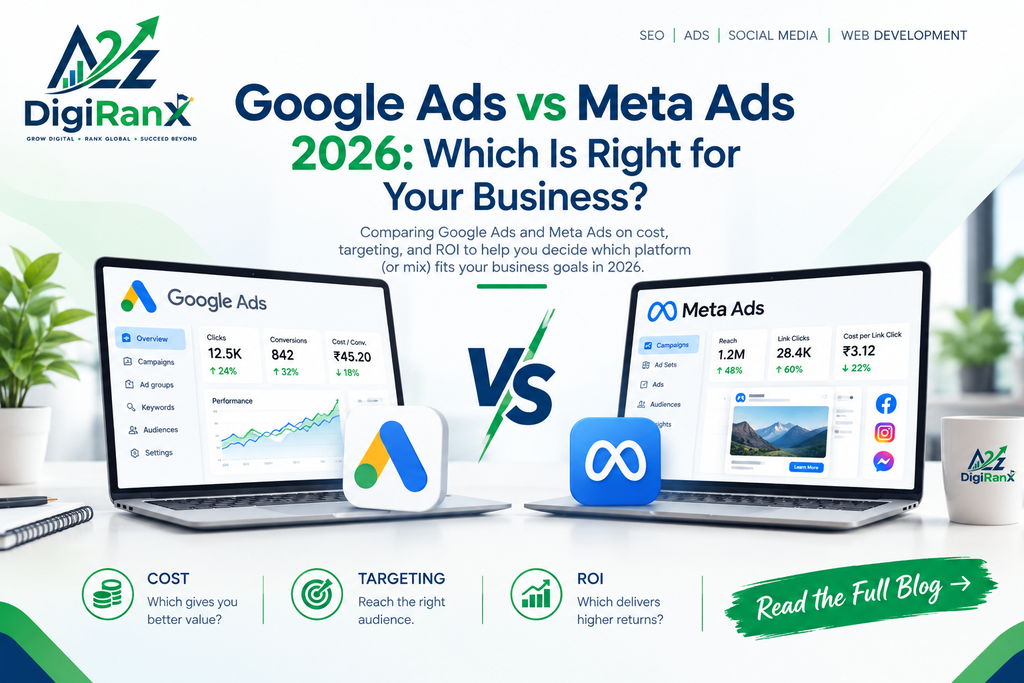
If you’re deciding where to spend your first (or next) advertising rupee, you’ve probably landed on the same question every business owner asks: Google Ads or Meta Ads which one actually works?
The honest answer is: it depends on what your customer is doing the moment they see your ad. Google Ads catches people who are already searching for a solution. Meta Ads reaches people who aren’t searching yet but might still buy once they see the right offer in their feed.
At A2Z DigiRanX, we help businesses cut through exactly this kind of confusion turning ad spend into real leads and revenue, whether that’s through Google Ads, Meta Ads, SEO, or all three.
In this guide, we’ll break down how each platform works, compare them on cost, targeting, and ROI, and help you decide whether you need Google Ads, Meta Ads, or both based on your business goals in 2026.
Want this decision made for you, backed by data instead of guesswork? Our Google Ads and Meta Ads management team can audit your business and tell you exactly where your budget should go.
What Is Google Ads?
Google Ads is a pay-per-click (PPC) advertising platform where businesses bid on keywords to show up on Google Search, YouTube, Gmail, and the Google Display Network. It’s built entirely around intent your ad appears when someone is actively typing in a search query related to what you sell.
If someone searches for “best accountant in Meerut” or “buy running shoes online,” Google Ads puts your business right in front of them at the exact moment they’re ready to act.
Curious how paid ads fit into the bigger picture? Read our post on GEO vs SEO vs AEO: Why You Need All Three in 2026.
What Is Meta Ads?
Meta Ads is the advertising platform used across Facebook, Instagram, Messenger, and the Meta Audience Network. Instead of matching ads to search queries, Meta targets people based on their interests, behavior, and demographics.
Meta Ads work on discovery someone scrolling Instagram isn’t looking to buy anything, but a well-placed, scroll-stopping ad can introduce them to a product or service they didn’t know they needed.
In short: Google Ads captures existing demand. Meta Ads creates new demand.
Google Ads vs Meta Ads: Key Differences
| Factor | Google Ads | Meta Ads |
|---|---|---|
| Targeting basis | Keywords & search intent | Interests, demographics, behavior |
| Best for | High-intent, ready-to-buy customers | Awareness, discovery, impulse buys |
| Average CPC | Generally higher (competitive keywords) | Generally lower |
| Creative requirement | Strong ad copy, keyword match | Strong visuals, video, storytelling |
| Speed to results | Faster, more predictable | Slower — algorithm needs to learn |
| Ad formats | Search, Display, Shopping, YouTube | Image, video, carousel, Collection, Instant Experience |
| Ideal industries | Services, B2B, urgent-need purchases | Fashion, lifestyle, visually-driven products |
Google Ads vs Meta Ads: Cost Comparison
Cost is usually the first thing business owners ask about, and it’s where the two platforms differ the most.
Google Ads works on a real-time auction system. The more advertisers competing for a keyword, the higher the cost-per-click. Industries like insurance, legal services, and finance often see some of the most expensive keywords in the market. But that higher cost usually comes with higher-intent traffic people who are close to making a decision.
Meta Ads typically offers a lower average CPC and more flexibility with small daily budgets, making it more accessible for businesses just starting with paid advertising. However, cheaper clicks don’t automatically mean better results Meta users are browsing, not actively shopping, so conversion rates can be lower without strong creative and clear targeting.
Bottom line: If your priority is transaction-ready traffic, expect to pay more on Google Ads. If your priority is reach and brand visibility on a smaller budget, Meta Ads usually stretches further.
Which Is Better for Lead Generation?
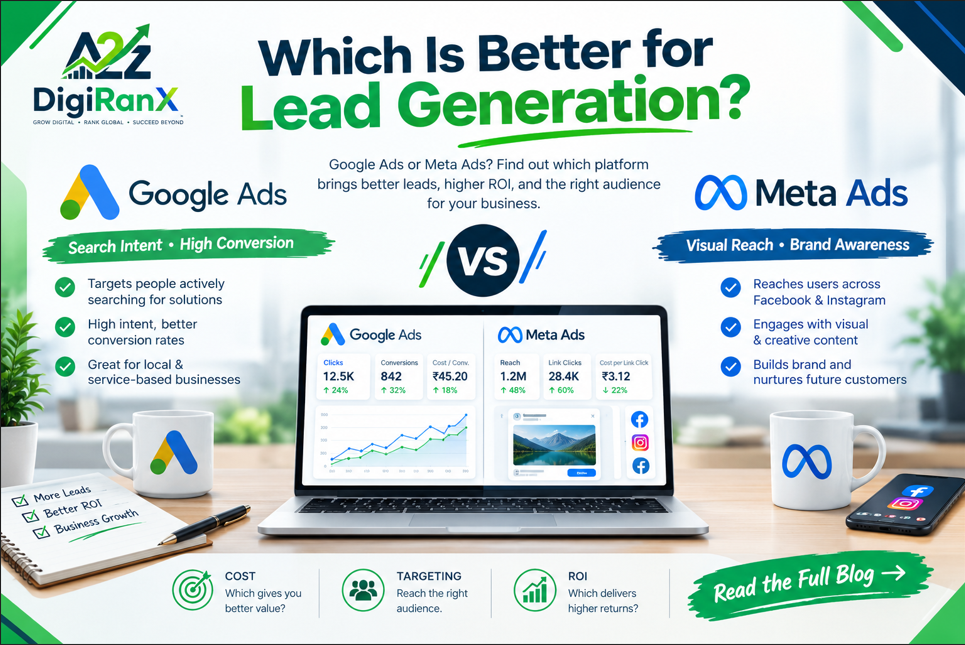
For most service-based and B2B businesses, Google Ads tends to win for lead generation. Since the user is already searching for a solution “digital marketing agency near me” or “SEO services in Uttar Pradesh” you’re not trying to convince them they have a problem. You’re simply the answer that shows up first.
Meta Ads can still generate leads effectively, especially with lead-form ads and retargeting, but it usually performs best further up the funnel building awareness before someone ever searches for you on Google.
This is exactly why many of the brands we work with at A2Z DigiRanX don’t choose one over the other; they run both in tandem, with our Google Ads and Meta Ads management services tying the two together into one funnel.
Which Is Better for E-Commerce?
E-commerce businesses often get the best results by using both platforms for different jobs:
- Meta Ads performs well for product discovery, especially with video or carousel ads showcasing the product in action great for impulse purchases and visually appealing products.
- Google Ads (Search + Shopping) captures people who already know what they want and are actively comparing prices or looking to buy immediately.
Running Meta Ads for top-of-funnel discovery and Google Ads for bottom-of-funnel conversion is one of the most effective combinations for online stores in 2026.
Which Is Better for Small Businesses and Startups?
If you’re working with a limited budget, Meta Ads is often the easier starting point lower CPCs, flexible daily spend, and detailed audience targeting let you test messaging and offers without a huge upfront investment.
That said, if your business depends on people actively searching for what you offer (a plumber, a clinic, a local service), Google Ads, particularly local SEO and Google My Business optimization paired with Search Ads will usually bring in more qualified leads faster.
So, Which Should You Choose: Google Ads or Meta Ads?
Here’s a simple way to decide:
- Choose Google Ads if: your customers actively search for what you sell, you’re in a service-based or B2B industry, or you need fast, measurable leads.
- Choose Meta Ads if: your product is visually appealing, you’re building brand awareness, or you want to reach people before they know they need you.
- Choose both if: you want a complete funnel Meta Ads to build awareness and warm up your audience, Google Ads to capture the demand once they start searching.
Most established brands don’t pick one platform permanently they shift budget between the two based on season, product launches, and funnel stage.
Frequently Asked Questions
What’s the main difference between Google Ads and Meta Ads?
Google Ads targets people actively searching for something (intent-based), while Meta Ads targets people based on interests, demographics, and behavior on Facebook and Instagram (discovery-based).
Is Google Ads or Meta Ads cheaper?
Meta Ads generally has a lower average cost-per-click than Google Ads, especially in competitive industries like finance, law, or insurance. However, lower cost doesn’t always mean higher-quality leads.
Which platform is better for lead generation?
Google Ads usually performs better for lead generation because users are already searching for a solution, resulting in higher intent and often shorter sales cycles.
Can I use both Google Ads and Meta Ads together?
Yes many businesses combine both: Google Ads to capture active demand and Meta Ads to build awareness and retarget people earlier in the funnel.
Which platform is better for small businesses with a limited budget?
Meta Ads is often more budget-friendly for small businesses due to lower CPCs and flexible daily budgets, making it easier to test campaigns before scaling.
Is Google Ads or Meta Ads better for e-commerce?
Both work well together Meta Ads tends to perform strongly for discovery and impulse purchases, while Google Search and Shopping Ads work best for people actively searching for a specific product.
How long does it take to see results from Google Ads vs Meta Ads?
Google Ads often shows faster, more predictable results since intent signals are explicit. Meta Ads can take longer, as its algorithm needs time to learn the right audience.
Do I need different creatives for Google Ads and Meta Ads?
Yes. Google Search Ads rely heavily on strong ad copy matched to keywords, while Meta Ads depend much more on strong visual creative images, video, and design.
Final Thoughts
There’s no universal winner between Google Ads and Meta Ads, only the right platform for your specific business, budget, and customer behavior. The businesses that win in 2026 aren’t the ones debating which platform is “better.” They’re the ones using each platform for what it does best, and letting data not guesswork decide where the next rupee goes.
If you’d rather have a team handle this strategy for you, A2Z DigiRanX manages Google Ads, Meta Ads, SEO, and AI/GEO visibility under one roof. Explore our services, check out our digital marketing courses if you want to learn this yourself, or read our previous post on GEO vs SEO vs AEO: Why You Need All Three in 2026 to see how paid ads fit into a complete visibility strategy.
Ready to figure out your ideal ad mix? Get in touch with our team for a free strategy consultation.
Pingback: GEO vs SEO vs AEO: Why Your Business Needs All Three in 2026